AI News and Guides

Explore the best AI News and Guides — independent reviews, comparisons, pricing and step-by-step how-to guides, curated by Aizhi.

  • Sample (graphics)

    Sample (graphics)

    In computer graphics, a sample is an intersection of a channel and a pixel. The diagram below depicts a 24-bit pixel, consisting of 3 samples for Red, Green, and Blue. In this particular diagram, the Red sample occupies 9 bits, the Green sample occupies 7 bits and the Blue sample occupies 8 bits, totaling 24 bits per pixel. Note that the samples do not have to be equal size and not all samples are mandatory in a pixel. Also, a pixel can consist of more than 3 samples (e.g. 4 samples of the RGBA color space). A sample is related to a subpixel on a physical display.

    Read more →
  • ArcSoft ShowBiz

    ArcSoft ShowBiz

    ShowBiz is a video editor by ArcSoft for the Windows operating system. It can create VCD and DVDs and can also export to the formats AVI, MPEG, WMV, and MOV. ShowBiz also contains a DVD burning and menu building feature. As of 2003, it was one of the three most dominant bundled titles. == Reception == PC Magazine reviewer Jan Ozer states: "ArcSoft's ShowBiz has evolved into a competent editor that's generally more usable than Dazzle's MovieStar program, providing more configuration controls, better preview features, and a much greater range of fun effects." John Virata, senior editor of Digital Media Online, says in his three page review of ShowBiz DVD 2, "It is an easy editor to work with and has a logically laid out interface that takes you step by step through the video creation and DVD creation process"

    Read more →
  • Human–robot collaboration

    Human–robot collaboration

    Human-Robot Collaboration is the study of collaborative processes in human and robot agents work together to achieve shared goals. Many new applications for robots require them to work alongside people as capable members of human-robot teams. These include robots for homes, hospitals, and offices, space exploration and manufacturing. Human-Robot Collaboration (HRC) is an interdisciplinary research area comprising classical robotics, human-computer interaction, artificial intelligence, process design, layout planning, ergonomics, cognitive sciences, and psychology. Industrial applications of human-robot collaboration involve Collaborative Robots, or cobots, that physically interact with humans in a shared workspace to complete tasks such as collaborative manipulation or object handovers. == Collaborative Activity == Collaboration is defined as a special type of coordinated activity, one in which two or more agents work jointly with each other, together performing a task or carrying out the activities needed to satisfy a shared goal. The process typically involves shared plans, shared norms and mutually beneficial interactions. Although collaboration and cooperation are often used interchangeably, collaboration differs from cooperation as it involves a shared goal and joint action where the success of both parties depend on each other. For effective human-robot collaboration, it is imperative that the robot is capable of understanding and interpreting several communication mechanisms similar to the mechanisms involved in human-human interaction. The robot must also communicate its own set of intents and goals to establish and maintain a set of shared beliefs and to coordinate its actions to execute the shared plan. In addition, all team members demonstrate commitment to doing their own part, to the others doing theirs, and to the success of the overall task. == Theories Informing Human-Robot Collaboration == Human-human collaborative activities are studied in depth in order to identify the characteristics that enable humans to successfully work together. These activity models usually aim to understand how people work together in teams, how they form intentions and achieve a joint goal. Theories on collaboration inform human-robot collaboration research to develop efficient and fluent collaborative agents. === Belief Desire Intention Model === The belief-desire-intention (BDI) model is a model of human practical reasoning that was originally developed by Michael Bratman. The approach is used in intelligent agents research to describe and model intelligent agents. The BDI model is characterized by the implementation of an agent's beliefs (the knowledge of the world, state of the world), desires (the objective to accomplish, desired end state) and intentions (the course of actions currently under execution to achieve the desire of the agent) in order to deliberate their decision-making processes. BDI agents are able to deliberate about plans, select plans and execute plans. === Shared Cooperative Activity === Shared Cooperative Activity defines certain prerequisites for an activity to be considered shared and cooperative: mutual responsiveness, commitment to the joint activity and commitment to mutual support. An example case to illustrate these concepts would be a collaborative activity where agents are moving a table out the door, mutual responsiveness ensures that movements of the agents are synchronized; a commitment to the joint activity reassures each team member that the other will not at some point drop his side; and a commitment to mutual support deals with possible breakdowns due to one team member's inability to perform part of the plan. === Joint Intention Theory === Joint Intention Theory proposes that for joint action to emerge, team members must communicate to maintain a set of shared beliefs and to coordinate their actions towards the shared plan. In collaborative work, agents should be able to count on the commitment of other members, therefore each agent should inform the others when they reach the conclusion that a goal is achievable, impossible, or irrelevant. == Approaches to Human-Robot Collaboration == The approaches to human-robot collaboration include human emulation (HE) and human complementary (HC) approaches. Although these approaches have differences, there are research efforts to develop a unified approach stemming from potential convergences such as Collaborative Control. === Human Emulation === The human emulation approach aims to enable computers to act like humans or have human-like abilities in order to collaborate with humans. It focuses on developing formal models of human-human collaboration and applying these models to human-computer collaboration. In this approach, humans are viewed as rational agents who form and execute plans for achieving their goals and infer other people's plans. Agents are required to infer the goals and plans of other agents, and collaborative behavior consists of helping other agents to achieve their goals. === Human Complementary === The human complementary approach seeks to improve human-computer interaction by making the computer a more intelligent partner that complements and collaborates with humans. The premise is that the computer and humans have fundamentally asymmetric abilities. Therefore, researchers invent interaction paradigms that divide responsibility between human users and computer systems by assigning distinct roles that exploit the strengths and overcome the weaknesses of both partners. == Key Aspects == Specialization of Roles: Based on the level of autonomy and intervention, there are several human-robot relationships including master-slave, supervisor–subordinate, partner–partner, teacher–learner and fully autonomous robot. In addition to these roles, homotopy (a weighting function that allows a continuous change between leader and follower behaviors) was introduced as a flexible role distribution. Establishing shared goal(s): Through direct discussion about goals or inference from statements and actions, agents must determine the shared goals they are trying to achieve. Allocation of Responsibility and Coordination: Agents must decide how to achieve their goals, determine what actions will be done by each agent, and how to coordinate the actions of individual agents and integrate their results. Shared context: Agents must be able to track progress toward their goals. They must keep track of what has been achieved and what remains to be done. They must evaluate the effects of actions and determine whether an acceptable solution has been achieved. Communication: Any collaboration requires communication to define goals, negotiate over how to proceed and who will do what, and evaluate progress and results. Adaptation and learning: Collaboration over time require partners to adapt themselves to each other and learn from one's partner both directly or indirectly. Time and space: The time-space taxonomy divides human-robot interaction into four categories based on whether the humans and robots are using computing systems at the same time (synchronous) or different times (asynchronous) and while in the same place (collocated) or in different places (non-collocated). Ergonomics: Human factors and ergonomics are one of the key aspects for a sustainable human-robot collaboration. The robot control system can use biomechanical models and sensors to optimize various ergonomic metrics, such as muscle fatigue.

    Read more →
  • Firefox Lockwise

    Firefox Lockwise

    Firefox Lockwise (formerly Lockbox) is a deprecated password manager for the Firefox web browser, as well as the mobile operating systems iOS and Android. On desktop, Lockwise was simply part of Firefox, whereas on iOS and Android it was available as a standalone app. If Firefox Sync was activated (with a Firefox account), then Lockwise synced passwords between Firefox installations across devices. It also featured a built-in random password generator. The application and branding have since been "phased out." == History == Developed by Mozilla, it was originally named Firefox Lockbox in 2018. It was renamed "Lockwise" in May 2019. It was introduced for iOS on 10 July 2018 as part of the Test Pilot program. On 26 March 2019, it was released for Android. On desktop, Lockwise started out as a browser addon. Alphas were released between March and August 2019. Since Firefox version 70, Lockwise has been integrated into the browser (accessible at about:logins), having replaced a basic password manager presented in a popup window. Mozilla ended support for Firefox Lockwise on December 13, 2021. As of January 2026, Lockwise is still fully functional on Android to this day.

    Read more →
  • Visual analytics

    Visual analytics

    Visual analytics is a multidisciplinary science and technology field that emerged from information visualization and scientific visualization. It focuses on how analytical reasoning can be facilitated by interactive visual interfaces. == Overview == Visual analytics is "the science of analytical reasoning facilitated by interactive visual interfaces." It can address problems whose size, complexity, and need for closely coupled human and machine analysis may make them otherwise intractable. Visual analytics advances scientific and technological development across multiple domains, including analytical reasoning, human–computer interaction, data transformations, visual representation for computation and analysis, analytic reporting, and the transition of new technologies into practice. As a research agenda, visual analytics brings together several scientific and technical communities from computer science, information visualization, cognitive and perceptual sciences, interactive design, graphic design, and social sciences. Visual analytics integrates new computational and theory-based tools with innovative interactive techniques and visual representations to enable human-information discourse. The design of the tools and techniques is based on cognitive, design, and perceptual principles. This science of analytical reasoning provides the reasoning framework upon which one can build both strategic and tactical visual analytics technologies for threat analysis, prevention, and response. Analytical reasoning is central to the analyst's task of applying human judgments to reach conclusions from a combination of evidence and assumptions. Visual analytics has some overlapping goals and techniques with information visualization and scientific visualization. There is currently no clear consensus on the boundaries between these fields, but broadly speaking the three areas can be distinguished as follows: Scientific visualization deals with data that has a natural geometric structure (e.g., MRI data, wind flows). Information visualization handles abstract data structures such as trees or graphs. Visual analytics is especially concerned with coupling interactive visual representations with underlying analytical processes (e.g., statistical procedures, data mining techniques) such that high-level, complex activities can be effectively performed (e.g., sense making, reasoning, decision making). Visual analytics seeks to marry techniques from information visualization with techniques from computational transformation and analysis of data. Information visualization forms part of the direct interface between user and machine, amplifying human cognitive capabilities in six basic ways: by increasing cognitive resources, such as by using a visual resource to expand human working memory, by reducing search, such as by representing a large amount of data in a small space, by enhancing the recognition of patterns, such as when information is organized in space by its time relationships, by supporting the easy perceptual inference of relationships that are otherwise more difficult to induce, by perceptual monitoring of a large number of potential events, and by providing a manipulable medium that, unlike static diagrams, enables the exploration of a space of parameter values These capabilities of information visualization, combined with computational data analysis, can be applied to analytic reasoning to support the sense-making process. == History == As an interdisciplinary approach, visual analytics has its roots in information visualization, cognitive sciences, and computer science. The term and scope of the field was defined in the early 2000s through researchers such as Jim Thomas, Kristin A. Cook, John Stasko, Pak Chung Wong, Daniel A. Keim and David S. Ebert. As a reaction to the September 11, 2001 attacks the United States Department of Homeland Security was established in late 2002, combining dozens of previously separated government agencies. Building upon earlier work on visual data mining by Daniel A. Keim starting in the late 1990s, this simultaneously lead to the development of a research agenda for visual analytics. As part of these efforts the National Visualization and Analytics Center (NVAC) at Pacific Northwest National Laboratory was established in 2004, whose charter was to develop system to mitigate information overload after the September 11, 2001 attacks in the intelligence community. Their research work determined core challenges, posed open research questions, and positioned visual analytics as a new research domain, in particular through the 2005 research agenda Illuminating the Path. In 2006, the IEEE VIS community led by Pak Chung Wong and Daniel A. Keim launched the annual IEEE Conference on Visual Analytics Science and Technology (VAST), providing a dedicated venue for research into visual analytics, which in 2020 merged to form the IEEE Visualization conference. In 2008, scope and challenges of visual analytics were conceptually defined by Daniel A. Keim and Jim Thomas in their influential book about visual data mining. The domain was further refined as part of the European Commissions FP7 VisMaster program in the late 2000s. == Topics == === Scope === Visual analytics is a multidisciplinary field that includes the following focus areas: Analytical reasoning techniques that enable users to obtain deep insights that directly support assessment, planning, and decision making Data representations and transformations that convert all types of conflicting and dynamic data in ways that support visualization and analysis Techniques to support production, presentation, and dissemination of the results of an analysis to communicate information in the appropriate context to a variety of audiences. Visual representations and interaction techniques that take advantage of the human eye's broad bandwidth pathway into the mind to allow users to see, explore, and understand large amounts of information at once. === Analytical reasoning techniques === Analytical reasoning techniques are the method by which users obtain deep insights that directly support situation assessment, planning, and decision making. Visual analytics must facilitate high-quality human judgment with a limited investment of the analysts’ time. Visual analytics tools must enable diverse analytical tasks such as: Understanding past and present situations quickly, as well as the trends and events that have produced current conditions Identifying possible alternative futures and their warning signs Monitoring current events for emergence of warning signs as well as unexpected events Determining indicators of the intent of an action or an individual Supporting the decision maker in times of crisis. These tasks will be conducted through a combination of individual and collaborative analysis, often under extreme time pressure. Visual analytics must enable hypothesis-based and scenario-based analytical techniques, providing support for the analyst to reason based on the available evidence. === Data representations === Data representations are structured forms suitable for computer-based transformations. These structures must exist in the original data or be derivable from the data themselves. They must retain the information and knowledge content and the related context within the original data to the greatest degree possible. The structures of underlying data representations are generally neither accessible nor intuitive to the user of the visual analytics tool. They are frequently more complex in nature than the original data and are not necessarily smaller in size than the original data. The structures of the data representations may contain hundreds or thousands of dimensions and be unintelligible to a person, but they must be transformable into lower-dimensional representations for visualization and analysis. === Theories of visualization === Theories of visualization include: Jacques Bertin's Semiology of Graphics (1967) Nelson Goodman's Languages of Art (1977) Jock D. Mackinlay's Automated design of optimal visualization (APT) (1986) Leland Wilkinson's Grammar of Graphics (1998) Hadley Wickham's Layered Grammar of Graphics (2010) === Visual representations === Visual representations translate data into a visible form that highlights important features, including commonalities and anomalies. These visual representations make it easy for users to perceive salient aspects of their data quickly. Augmenting the cognitive reasoning process with perceptual reasoning through visual representations permits the analytical reasoning process to become faster and more focused. == Process == The input for the data sets used in the visual analytics process are heterogeneous data sources (i.e., the internet, newspapers, books, scientific experiments, expert systems). From these rich sources, the data sets S = S1, ..., Sm are chosen, whereas each Si , i ∈ (1, ..., m) consists of attrib

    Read more →
  • Super-resolution optical fluctuation imaging

    Super-resolution optical fluctuation imaging

    Super-resolution optical fluctuation imaging (SOFI) is a post-processing method for the calculation of super-resolved images from recorded image time series that is based on the temporal correlations of independently fluctuating fluorescent emitters. SOFI has been developed for super-resolution of biological specimen that are labelled with independently fluctuating fluorescent emitters (organic dyes, fluorescent proteins). In comparison to other super-resolution microscopy techniques such as STORM or PALM that rely on single-molecule localization and hence only allow one active molecule per diffraction-limited area (DLA) and timepoint, SOFI does not necessitate a controlled photoswitching and/ or photoactivation as well as long imaging times. Nevertheless, it still requires fluorophores that are cycling through two distinguishable states, either real on-/off-states or states with different fluorescence intensities. In mathematical terms SOFI-imaging relies on the calculation of cumulants, for what two distinguishable ways exist. For one thing an image can be calculated via auto-cumulants that by definition only rely on the information of each pixel itself, and for another thing an improved method utilizes the information of different pixels via the calculation of cross-cumulants. Both methods can increase the final image resolution significantly although the cumulant calculation has its limitations. Actually SOFI is able to increase the resolution in all three dimensions. == Principle == Likewise to other super-resolution methods SOFI is based on recording an image time series on a CCD- or CMOS camera. In contrary to other methods the recorded time series can be substantially shorter, since a precise localization of emitters is not required and therefore a larger quantity of activated fluorophores per diffraction-limited area is allowed. The pixel values of a SOFI-image of the n-th order are calculated from the values of the pixel time series in the form of a n-th order cumulant, whereas the final value assigned to a pixel can be imagined as the integral over a correlation function. The finally assigned pixel value intensities are a measure of the brightness and correlation of the fluorescence signal. Mathematically, the n-th order cumulant is related to the n-th order correlation function, but exhibits some advantages concerning the resulting resolution of the image. Since in SOFI several emitters per DLA are allowed, the photon count at each pixel results from the superposition of the signals of all activated nearby emitters. The cumulant calculation now filters the signal and leaves only highly correlated fluctuations. This provides a contrast enhancement and therefore a background reduction for good measure. As it is implied in the figure on the left the fluorescence source distribution: ∑ k = 1 N δ ( r → − r → k ) ⋅ ε k ⋅ s k ( t ) {\displaystyle \sum _{k=1}^{N}\delta ({\vec {r}}-{\vec {r}}_{k})\cdot \varepsilon _{k}\cdot s_{k}(t)} is convolved with the system's point spread function (PSF) U(r). Hence the fluorescence signal at time t and position r → {\displaystyle {\vec {r}}} is given by F ( r → , t ) = ∑ k = 1 N U ( r → − r → k ) ⋅ ε k ⋅ s k ( t ) . {\displaystyle F({\vec {r}},t)=\sum _{k=1}^{N}U({\vec {r}}-{\vec {r}}_{k})\cdot \varepsilon _{k}\cdot s_{k}(t).} Within the above equations N is the amount of emitters, located at the positions r → k {\displaystyle {\vec {r}}_{k}} with a time-dependent molecular brightness ε k ⋅ s k {\displaystyle \varepsilon _{k}\cdot s_{k}} where ε k {\displaystyle \varepsilon _{k}} is a variable for the constant molecular brightness and s k ( t ) {\displaystyle s_{k}(t)} is a time-dependent fluctuation function. The molecular brightness is just the average fluorescence count-rate divided by the number of molecules within a specific region. For simplification it has to be assumed that the sample is in a stationary equilibrium and therefore the fluorescence signal can be expressed as a zero-mean fluctuation: δ F ( r → , t ) = F ( r → , t ) − ⟨ F ( r → , t ) ⟩ t {\displaystyle \delta F({\vec {r}},t)=F({\vec {r}},t)-\langle F({\vec {r}},t)\rangle _{t}} where ⟨ ⋯ ⟩ t {\displaystyle \langle \cdots \rangle _{t}} denotes time-averaging. The auto-correlation here e.g. the second-order can then be described deductively as follows for a certain time-lag τ {\displaystyle \tau } : δ F ( r → , t ) = ⟨ δ F ( r → , t + τ ) ⋅ δ F ( r → , t ) ⟩ t {\displaystyle \delta F({\vec {r}},t)=\langle \delta F({\vec {r}},t+\tau )\cdot \delta F({\vec {r}},t)\rangle _{t}} From these equations it follows that the PSF of the optical system has to be taken to the power of the order of the correlation. Thus in a second-order correlation the PSF would be reduced along all dimensions by a factor of 2 {\displaystyle {\sqrt {2}}} . As a result, the resolution of the SOFI-images increases according to this factor. === Cumulants versus correlations === Using only the simple correlation function for a reassignment of pixel values, would ascribe to the independency of fluctuations of the emitters in time in a way that no cross-correlation terms would contribute to the new pixel value. Calculations of higher-order correlation functions would suffer from lower-order correlations for what reason it is superior to calculate cumulants, since all lower-order correlation terms vanish. == Cumulant-calculation == === Auto-cumulants === For computational reasons it is convenient to set all time-lags in higher-order cumulants to zero so that a general expression for the n-th order auto-cumulant can be found: A C n ( r → , τ 1 … n − 1 = 0 ) = ∑ k = 1 N U n ( r → − r → k ) ε k n w k ( 0 ) {\displaystyle AC_{n}({\vec {r}},\tau _{1\ldots n-1}=0)=\sum _{k=1}^{N}U^{n}({\vec {r}}-{\vec {r}}_{k})\varepsilon _{k}^{n}w_{k}(0)} w k {\displaystyle w_{k}} is a specific correlation based weighting function influenced by the order of the cumulant and mainly depending on the fluctuation properties of the emitters. Albeit there is no fundamental limitation in calculating very high orders of cumulants and thereby shrinking the FWHM of the PSF there are practical limitations according to the weighting of the values assigned to the final image. Emitters with a higher molecular brightness will show a strong increase in terms of the pixel cumulant value assigned at higher-orders as well as this performance can be expected from a diverse appearance of fluctuations of different emitters. A wide intensity range of the resulting image can therefore be expected and as a result dim emitters can get masked by bright emitters in higher-order images:. The calculation of auto-cumulants can be realized in a very attractive way in a mathematical sense. The n-th order cumulant can be calculated with a basic recursion from moments K n ( r → ) = μ n ( r → ) − ∑ i = 1 n − 1 ( n − 1 i ) K n − i ( r → ) μ i ( r → ) {\displaystyle K_{n}({\vec {r}})=\mu _{n}({\vec {r}})-\sum _{i=1}^{n-1}{\begin{pmatrix}n-1\\i\end{pmatrix}}K_{n-i}({\vec {r}})\mu _{i}({\vec {r}})} where K is a cumulant of the index's order, likewise μ {\displaystyle \mu } represents the moments. The term within the brackets indicates a binomial coefficient. This way of computation is straightforward in comparison with calculating cumulants with standard formulas. It allows for the calculation of cumulants with only little time of computing and is, as it is well implemented, even suitable for the calculation of high-order cumulants on large images. === Cross-cumulants === In a more advanced approach cross-cumulants are calculated by taking the information of several pixels into account. Cross-cumulants can be described as follows: C C n ( r → , τ 1 … n − 1 = 0 ) = ∏ j < l n U ( r → j − r → l n ) ⋅ ∑ i = 1 N U n ( r → i − ∑ k n r → k n ) ε i n w i ( 0 ) {\displaystyle CC_{n}({\vec {r}},\tau _{1\ldots n-1}=0)=\prod _{j Read more →

  • PhotoWorks (ray tracing software)

    PhotoWorks (ray tracing software)

    PhotoWorks is a raytrace rendering program created by Dassault Systèmes SolidWorks Corporation, formerly supplied as a photorealistic rendering add-in for SolidWorks. The program is based on the Mental Ray rendering engine. It has a library of scenes and materials that can be used with user-created SolidWorks files to create still frame images within the SolidWorks GUI. Since the 2011 release of SolidWorks, PhotoWorks has been replaced by the PhotoView 360 rendering utility. A 2010 review comparing PhotoWorks with three other rendering programs for SolidWorks (including PhotoView 360) gave the program high marks for render speed and built-in materials, but low marks for realism and user interface. Appearance File Type: .p2m

    Read more →
  • Voice search

    Voice search

    Voice search, also called voice-enabled search, allows the user to use a voice to search the Internet, a website, or an app. In a broader definition, voice search includes open-domain keyword query on any information on the Internet, for example in Google Voice Search, Cortana, Siri and Amazon Echo. Voice search is often interactive, involving several rounds of interaction that allows a system to ask for clarification. Voice search is a type of dialog system. Voice search is not a replacement for typed search. Rather the search terms, experience and use cases can differ heavily depending on the input type. == Supported language == Language is the most essential factor for a system to understand, and provide the most accurate results of what the user searches. This covers across languages, dialects, and accents, as users want a voice assistant that both understands them and speaks to them understandably. While spoken and written languages differ, voice search should support natural spoken language instead of only transforming voice into text and doing a regular text search with the help speech recognition. For example, in typed search an eCommerce user can easily copy and paste an alphanumeric product code to search field, but when speaking the search terms can be very different, such as "show me the new Bluetooth headphones by Samsung". == How it works == The difference between text and voice search is not only the input type. The mechanism must include an automatic speech recognition (ASR) for input, but it can also include natural language understanding for natural spoken search queries such as "What's the population for the United States" It can include text-to-speech (TTS) or a regular display for output modalities. Users might sometimes be required to activate the search by using a wake word. Then, the search system will detect the language spoken by the user. It will then detect the keywords and context of the sentence. Lastly, the device will return results depending on its output. A device with a screen might display the results, while a device without a screen will speak them back to the searcher.

    Read more →
  • Nolot

    Nolot

    Nolot is a chess test suite with 11 positions from real games. They were compiled by Pierre Nolot (French: [nɔ.lo]) for the French chess magazine Gambisco and posted on the rec.games.chess Usenet group in 1994. They were designed to be particularly hard to solve for chess engines to solve at the time, although modern engines can find a solution near-instantaneously. == Problem 1 == FEN: r3qb1k/1b4p1/p2pr2p/3n4/Pnp1N1N1/6RP/1B3PP1/1B1QR1K1 w - - 0 1 26.Nxh6!! c3 (26... Rxh6 27.Nxd6 Qh5 (best) 28.Rg5! Qxd1 29.Nf7+ Kg8 30.Nxh6+ Kh8 31.Rxd1 c3 32.Nf7+ Kg8 33.Bg6! Nf4 34.Bxc3 Nxg6 35.Bxb4 Kxf7 36.Rd7+ Kf6 37.Rxg6+ Kxg6 38.Rxb7 ±) 27.Nf5! cxb2 28.Qg4 Bc8 (28... g6!? 29.Kh2! 29.Qd7 30.Nh4 Bc6 31.Nc5! dxc 32.Rxe6 Nf6 33.Nxg6+ Kg7 34.Qg5 Nbd5 35.Ne5 Kh8 36.Nxd7 ±) 29.Qh4+ Rh6 30.Nxh6 gxh6 31.Kh2! Qe5 32.Ng5 Qf6 33.Re8 Bf5 34.Qxh6 (missing a mate in 6: 34.Nf7+ Qxf7 35.Qxh6+ Bh7 36.Rxa8 Nf6 37.Rxf8 Qxf8 38.Qxf8+ Ng8 39.Qg7#) 34...Qxh6 35.Nf7+ Kh7 36.Bxf5+ Qg6 37.Bxg6+ Kg7 38.Rxa8 Be7 39.Rb8 a5 40.Be4+ Kxf7 41.Bxd5+ 1–0 The best Novag computer, the Diablo 68000, finds 26. Nxh6 after seven and a half months (Pierre Nolot has let it run on the position for 14 months and one day, until a power failure stopped an analysis of over 80,000,000,000 nodes.) but for wrong reasons: it evaluates white's position as inferior and thinks this move would enable it to draw. Today Gambit Tiger 2.0 for example can find it quite quickly: Most free engines running on 64-bit processors in 2010 could solve this problem and the others in a few seconds. 1.Qd4 c3 2.Bxc3 Nxc3 3.Qxb4 Nxe4 4.Qxb7 Rb8 5.Qxb8 Qxb8 6.Bxe4 d5 7.Rb1 μ (-1.20) Depth: 12 00:00:09 6055 kN 1.Nxh6 c3 2.Nf5 cxb2 3.Qg4 Rb8 4.Nxg7 Rg6 5.Qxg6 Qxg6 6.Rxg6 Bxg7 7.Nxd6 ³ (-0.48) Depth: 12 00:00:21 14368 kN 1.Nxh6 c3 2.Nf5 cxb2 3.Qg4 Rc8 4.Nxg7 Rg6 5.Nxe8 Rxg4 6.Rxg4 Rxe8 7.Rg6 μ (-0.74) Depth: 13 00:00:55 38455 kN 1.Ne3 Rxe4 2.Bxe4 Qxe4 3.Nxd5 Qxd5 4.Qc1 Qf5 5.Qxh6+ Qh7 6.Qe6 Nd3 7.Re2 Nxb2 8.Rxb2 ³ (-0.58) Depth: 13 00:01:30 62979 kN 1.Ne3 Rxe4 ³ (-0.58) Depth: 14 00:02:02 84941 kN 1.Ne3 Nxe3 2.Rexe3 Bxe4 3.Qg4 Rg6 4.Qxe4 Qxe4 5.Bxe4 Rxg3 6.Rxg3 d5 7.Bf5 Re8 8.Bc3 ³ (-0.30) Depth: 15 00:03:05 128968 kN 1.Nxh6 ² (0.32) Depth: 15 00:07:58 350813 kN With the next ply showing a clear advantage. Stockfish 14dev 64bit 4CPU running on 2020 hardware recognises the significance of Nxh6!! in 1 second. Stockfish_21092606_x64_avx2: NNUE evaluation using nn-13406b1dcbe0.nnue enabled. 19/32 00:01 7708k 4882k +3,00 Nxh6 Rxh6 Nxd6 Qh5 Bg6 Qxd1 Nf7+ Kg8 Nxh6+ gxh6 Bh5+ Kh7 Rxd1 c3 Bxc3 Nxc3 Rd7+ Kh8 Rxb7 Ne4 Re3 Nxf2 Kxf2 Bc5 Ke2 Bxe3 Kxe3 Nd5+ Kf2 49/73 15:02 5118270k 5673k +6,15 Nxh6 Rxh6 Nxd6 Qh5 Rg5 Qxd1 Nf7+ Kg8 Nxh6+ Kh8 Rxd1 c3 Nf7+ Kg8 Bg6 Nf4 Bxc3 Nbd5 Rb1 Bc6 Bd2 Nxg6 Rxg6 Ne7 Rxc6 Nxc6 Rb6 Rc8 Ng5 a5 Ra6 Bb4 Be3 Ne5 Bd4 Nc6 Bb6 Bd2 h4 Kf8 Bc5+ Kg8 Be3 Bxe3 fxe3 Kf8 Kf2 Ke7 Nf3 Kd7 Rb6 Ne7 Rb5 Kd6 Rxa5 Rc2+ Kg3 Re2 Nd4 Rxe3+ Kf4 Rd3 Nf5+ Kc7 Nxe7 == Problem 2 == FEN: r4rk1/pp1n1p1p/1nqP2p1/2b1P1B1/4NQ2/1B3P2/PP2K2P/2R5 w - - 0 1 22.Rxc5!! Nxc5 23.Nf6+ Kh8 24.Qh4 Qb5+ (computers think there is perpetual check here, but...) 25.Ke3! 25... h5 26.Nxh5 Qxb3+ (26... d5+ 27.Bxd5 Qd3 28.Kf2 Ne4+ 29.Bxe4 Qd4+ 30.Kg2 Qxb2+ 31.Kh3 ±) and White won in 41 moves. Today Deep Junior 8.ZX for example finds it very quickly (around 1 minute): 1.Kd1 Rac8 2.Bh6 Qb5 3.Rc3 Qf1+ 4.Kc2 Rc6 5.Bxf8 −+ (-2.11) Depth: 12 00:00:04 10422 kN 1.Nxc5 Nxc5 2.Rxc5 Qxc5 3.e6 Rae8 4.e7 Nc8 5.Kf1 Nxd6 6.Bf6 b5 −+ (-2.10) Depth: 12 00:00:14 25054 kN 1.Bf6! μ (-1.35) Depth: 12 00:00:17 34601 kN 1.Bf6 Qb5+ 2.Ke1 Bb4+ 3.Kf2 Bc5+ = (0.00) Depth: 12 00:00:20 34601 kN 1.Bf6 Qb5+ 2.Ke1 Nxf6 3.Nxf6+ Kg7 4.Nh5+ gxh5 5.Qf6+ Kg8 6.Qg5+ Kh8 7.Qf6+ = (0.00) Depth: 15 00:01:01 130544 kN 1.Rxc5! = (0.15) Depth: 15 00:01:12 145875 kN 1.Rxc5 Nxc5 2.Nf6+ Kh8 3.Qh4 Qb5+ 4.Ke3 h5 5.Nxh5 Qd3+ 6.Kf2 Ne4+ 7.fxe4 Qd4+ 8.Kf1 Qd3+ 9.Ke1 Qb1+ 10.Bd1 ± (2.18) Depth: 15 00:01:18 145875 kN Stockfish 14dev 64bit 4CPU running on 2020 hardware recognises the significance of Rxc5!! in 1 second. Stockfish_21092606_x64_avx2: NNUE evaluation using nn-13406b1dcbe0.nnue enabled. 21/25 00:01 5822k 5545k +6,61 Rxc5 Qxc5 Nxc5 Nxc5 Bh6 Nbd7 Bxf8 Rxf8 Qe3 Rc8 f4 Nxe5 Qxe5 Ne6 Bxe6 Rc2+ Kd3 Rxh2 46/86 11:27 5057055k 7355k +7,61 Rxc5 Qxc5 Nxc5 Nxc5 Bf6 Ne6 Qh6 Nd4+ Kf2 Nf5 Qg5 Nd7 h4 Nxf6 Qxf6 Ng7 d7 b5 Bd5 Rab8 b4 Nh5 Bxf7+ Rxf7 d8R+ Rxd8 Qxd8+ Rf8 Qd5+ Kg7 e6 Kf6 Qd7 Ng7 Qd4+ Kxe6 Qxg7 Rf7 Qc3 Ke7 Qc5+ Ke8 Qc8+ Ke7 h5 gxh5 Kg3 h4+ Kh2 h6 Qc5+ Kf6 Qxb5 Kg7 f4 Rxf4 Qe5+ Rf6 b5 h3 Qd4 Kg8 Qxf6 h5 Blacks 22. .. Nxc5 is suboptimal and leads faster mate 77/44 09:18 6987714k 12518k +M22 Nf6+ Kh8 Qh4 Qb5+ Ke3 Qxb3+ axb3 h5 Nxh5 Nd5+ Kd4 Ne6+ Kxd5 Nxg5 Qxg5 gxh5 f4 Rad8 f5 f6 Qxh5+ Kg7 Qg6+ Kh8 e6 b6 e7 Rb8 exf8Q+ Rxf8 Ke6 b5 Ke7 Rb8 Qh5+ Kg7 Qf7+ Kh8 Kxf6 Rf8 Qxf8+ Kh7 Qg7+ == Problem 3 == FEN: r2qk2r/ppp1b1pp/2n1p3/3pP1n1/3P2b1/2PB1NN1/PP4PP/R1BQK2R w KQkq - 0 1 12.Nxg5!! Bxd1 13.Nxe6 Qb8 14.Nxg7+!! Kf8 15.Bh6! Bg4 16.0-0+ Kg8 17.Rf4 ± White wins with a queen sac but black has defensive resources. Stockfish 8 64bit 3CPU running on 2016 hardware recognizes the significance of Nxg5!! in 55 seconds. Stockfish 14 dev (Stockfish_21092606_x64_avx2) 64bit 4CPU running on 2020 hardware recognizes the significance of Nxg5!! in 1 second. NNUE evaluation using nn-13406b1dcbe0.nnue enabled. 21/34 00:01 8291k 4530k +2,78 Nxg5 Bxd1 Nxe6 Qb8 Nxg7+ Kd8 Kxd1 b5 N3f5 Bf8 Rf1 Kc8 Nh5 Kb7 Bxb5 Ne7 g4 a6 Ba4 Nxf5 gxf5 Ka7 Nf4 c5 47/59 37:49 10390430k 4578k +3,16 Nxg5 Bxd1 Nxe6 Qb8 Nxg7+ Kd8 Kxd1 b5 Rf1 Kc8 N3f5 Bf8 Ne6 Kd7 Nf4 Ne7 g4 a5 Ke2 Qb7 h4 Ra6 a3 Kc8 Be3 Kb8 Kf3 Rb6 Bd2 Qc8 Kg3 c5 Be3 c4 Nxe7 Bxe7 Bf5 Qd8 h5 Qg8 Kh3 Bg5 Rf3 Ra6 Raf1 b4 Nxd5 Qxd5 Bxg5 bxc3 bxc3 Rb6 Be3 Rb3 Blacks 14 .. Kf8 is suboptimal and leads loss fast 41/68 06:31 3269727k 8350k +9,28 Bh6 Kg8 Rxd1 Bf8 N3h5 Bxg7 Nxg7 Qf8 Nf5 Ne7 Bxf8 Nxf5 Bxf5 Rxf8 Be6+ Kg7 Rd3 Rf4 Bxd5 c6 Rg3+ Kf8 Rf3 Rxf3 Bxf3 Kg7 Rf1 Re8 Be4 Re6 Ke2 a5 Ke3 Rh6 h3 a4 Kf4 Re6 h4 Re8 Ke3 h6 h5 Rf8 Rxf8 Kxf8 == Problem 4 == FEN: r1b1kb1r/1p1n1ppp/p2ppn2/6BB/2qNP3/2N5/PPP2PPP/R2Q1RK1 w kq - 0 1 10.Nxe6!! Qxe6 11.Nd5 Kd8 12.Bg4 Qe5 13.f4 Qxe4 (13...Qxb2 stronger but not sufficient: 14.Bxd7 Bxd7 15.Rb1 Qa3 16.Nxf6 Bb5 17.Qd4 Qc5 18.Rfd1 ±) 14.Bxd7 Bxd7 15.Nxf6 gxf6 16.Bxf6+ Kc7 17.Bxh8 and Black resigned on move 27. Stockfish 14dev 64bit 4CPU running on 2020 hardware recognises the significance of 10.Nxe6 in 1 second. Stockfish_21092606_x64_avx2: NNUE evaluation using nn-13406b1dcbe0.nnue enabled. 22/37 00:01 6955k 5367k +4,00 Nxe6 Qxe6 Nd5 Kd8 Bg4 Qe5 f4 Qxb2 Rb1 Qa3 Bxd7 Bxd7 Nxf6 Bb5 Rf3 Qxa2 c4 Bxc4 Rf2 Qa5 Nd5+ f6 Nxf6 Kc7 Rc1 b5 Qd5 gxf6 Bxf6 Kb8 Rxc4 Qe1+ Rf1 51/70 47:10 14538911k 5137k +5,76 Nxe6 Qxe6 Nd5 Kd8 Bg4 Qe5 f4 Qxe4 Bxd7 Bxd7 Nxf6 Qf5 Qd4 Kc8 Nd5 Bc6 c4 f6 Nb6+ Kb8 Bh4 Be7 Rae1 Bd8 Nxa8 Kxa8 Bf2 Kb8 Qxd6+ Bc7 Ba7+ Kc8 Qe6+ Qxe6 Rxe6 h5 h4 Rd8 Re7 g6 Be3 Ba5 Kf2 Rd6 Rc1 Bd8 Rg7 Be4 Rg8 Kd7 c5 Rd3 Rc4 Bd5 Rg7+ Ke6 Rd4 Rxd4 Bxd4 Kf5 Rd7 Bc6 Rxd8 Kxf4 Bxf6 == Problem 5 == FEN: r2qrb1k/1p1b2p1/p2ppn1p/8/3NP3/1BN5/PPP3QP/1K3RR1 w - - 0 1 21.e5!! dxe5 22.Ne4! Nh5 23.Qg6!? (stronger is 23.Qg4!! Nf4 24.Nf3 Qc7 25.Nh4 ± ) 23...exd4? (23...Nf4 24.Rxf4! exf4 25.Nf3! Qb6 26.Rg5!! covering b5 and threatening Nf6 or Ne5-f7+) 24.Ng5 1−0 Stockfish 8 64bit 3CPU running on 2016 hardware recognises the significance of 21.e5 in 5 seconds. Stockfish 12 dev (Stockfish_20062212_x64_modern) 64bit 1CPU running on 2016 hardware recognizes the significance of 21.e5 in 11 seconds. 25/42 00:06 7 963k 1309k +6,93 e5 Nh5 Ne4 dxe5 Nf3 Nf4 Qg4 Qc7 Nh4 Bc6 Nf6 g5 Rxf4 exf4 Qh5 Qe7 Ng6+ Kg7 Nxe7 Rxe7 Ng4 37/62 03:12 298 083k 1545k +10,70 e5 Ng4 Qxg4 Qg5 Qh3 Qxe5 Nde2 g5 Rxf8+ Kg7 Rff1 Rf8 Re1 Qf5 Qg3 Rad8 Nd4 Qf4 Nxe6+ Bxe6 Rxe6 Qxg3 == Problem 6 == FEN: rnbqk2r/1p3ppp/p7/1NpPp3/QPP1P1n1/P4N2/4KbPP/R1B2B1R b kq - 0 1 13... axb5!! offers an exchange to keep the white queen out of play. 14.Qxa8 Bd4 15.Nxd4 cxd4 16.Qxb8 0-0! 17.Ke1 Qh4 18.g3 Qf6 19.Bf4 g5? (Ivanchuk found 19...d3! during post-game analysis.) 20.Rc1 exf4 21.Qxf4 Qd4 22.Rd1 bxc4 23.e5 Qc3+ 24.Rd2 Re8 25.Bxd3 cxd3 −+ Tasc R30 finds 19... d3! in 2 1/2 hours. 19... Bf5!! is even stronger than 19... d3. Position is already lost at 19... d3 +8.00 for black, ... Bf5 not much better Stockfish 14dev 64bit 4CPU running on 2020 hardware recognises the significance of axb5!! in 1 second. Stockfish_21092606_x64_avx2: NNUE evaluation using nn-13406b1dcbe0.nnue enabled. 21/28 00:01 9264k 4714k -1,22 axb5 Qxa8 Bd4 Nxd4 cxd4 h3 Nf6 Bg5 0-0 cxb5 h6 Bxf6 Qxf6 Re1 Nd7 Kd1 Qg6 Qa4 Qg3 Qc2 Qxa3 Bd3 Qxb4 Qb1 46/67 1:05:00 18113493k 4644k -2,40 axb5 Qxa8 Bd4 h3 Nf6 Nxd4 exd4 Kf2 Nxe4+ Kg1 Nd7 Bg5 Qxg5 Qxc8+ Ke7 Qc7 Qe5 d6+ Qxd6 Qxd6+ Kxd6 bxc5+ Ndxc5 cxb5 d3 h4 d2 Rh3 Ke5 Be2 f5 Ra2 Rd8 Bd1 Rd4 Re3 f4 Re2 b6 a4 Kd6 Rc2 Kd5 Ra2 h6 Rb2 Nxa4 Bxa4 Rxa4 Rexd2+ Nxd2 Rxd2+ Kc4 Rd7 g6 == Problem 7 == FEN 1r1bk2r/2R2ppp/p3p3/1b2P2q/4QP2/4N3/1B4PP/3R2K1 w k - 0 1 1.Rxd8+!! Rxd8 (1...Kxd8 2.Ra7! Qe2 3.Qd4+ Ke8 4.h3 Qe1+ 5.Kh2 Rd8 6.Qc5 Qh4 7.Ba3 Rd7 8.Ra8+ Rd8 9.g3 1−0)

    Read more →
  • VideoThang

    VideoThang

    VideoThang was free video editing software for Windows 2000, XP, and Vista. The software has three parts to it which are My Stuff, Edit My Stuff, and My Mix. The software accepts MOV, AVI, MPG, MP4, PNG, WMV, FLV, and MP3 standards. Its official website is now no longer available. == Reception == Jan Ozer, of Pcmag, said that the software "suffers from several unfortunate design and implementation flaws that dramatically limit output quality and overall utility." Jon L. Jacobi, of PC World, said that the software "may not be the most flexible multimedia editor in the world, but the trim/zoom basics are there, it's free, and it's so simple to use that just about anyone in the world should be able figure it out." Amit Agarwal, of Digital Inspiration, said that the software "doesn’t offer loads of features like other video editors but is perfect for making quick video slideshows of your pictures that you can upload on the web or share via email."

    Read more →
  • Educational robotics

    Educational robotics

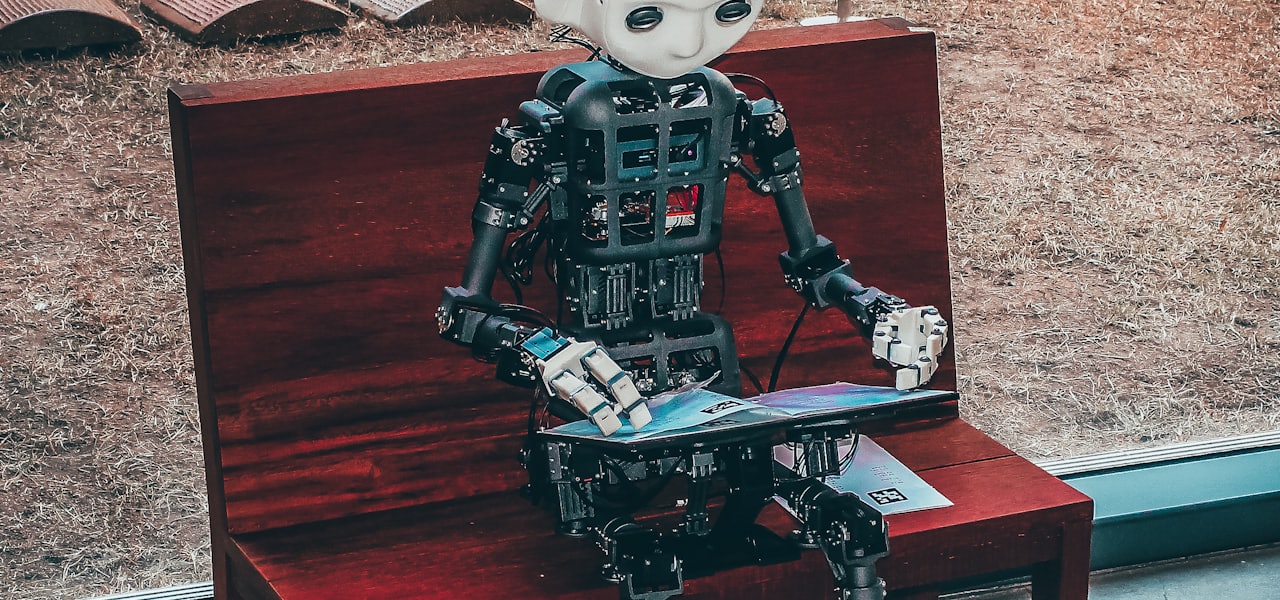
    Educational robotics teaches the design, analysis, application and operation of robots. Robots include articulated robots, mobile robots or autonomous vehicles. Educational robotics can be taught from elementary school to graduate programs. Robotics may also be used to motivate and facilitate the instruction other, often foundational, topics such as computer programming, artificial intelligence or engineering design. == Education and training == Robotics engineers design robots, maintain them, develop new applications for them, and conduct research to expand the potential of robotics. Robots have become a popular educational tool in some middle and high schools, as well as in numerous youth summer camps, raising interest in programming, artificial intelligence and robotics among students. First-year computer science courses at several universities now include programming of a robot in addition to traditional software engineering-based coursework. == Category of Educational robotics == The categories of educational robots seen as having more than one category. It can be alienated into different categories based on their physical design and coding method. Generally they are categorised as arm robots, wheeled mobile robots and humanoid robots. Tangibly, coded robots uses a physical means of coding instead of the screens coding. === Initiatives in schools === Leachim, was a robot teacher programmed with the class curricular, as well as certain biographical information on the 40 students whom it was programmed to teach. Leachim could synthesize human speech using Diphone synthesis. It was invented by Michael J. Freeman in 1974 and was tested in a fourth grade classroom in the Bronx, New York. === Post-secondary degree programs === From approximately 1960 through 2005, robotics education at post-secondary institutions took place through elective courses, thesis experiences and design projects offered as part of degree programs in traditional academic disciplines, such as mechanical engineering, electrical engineering, industrial engineering or computer science. Since 2005, more universities have begun granting degrees in robotics as a discipline in its own right, often under the name "Robotic Engineering". Based on a 2015 web-based survey of robotics educators, the degree programs and their estimates annual graduates are listed alphabetically below. Note that only official degree programs where the word "robotics" appears on the transcript or diploma are listed here; whereas degree programs in traditional disciplines with course concentrations or thesis topics related to robotics are deliberately omitted. === Certification === The Robotics Certification Standards Alliance (RCSA) is an international robotics certification authority that confers various industry- and educational-related robotics certifications. === Summer robotics camp === Several summer camp programs include robotics as part of their core curriculum. In addition, youth summer robotics programs are frequently offered by celebrated museums such as the American Museum of Natural History and The Tech Museum of Innovation in Silicon Valley, CA, just to name a few. There are of benefits that come from attending robotics camps. It teaches students how to use teamwork, resilience and motivation, and decision-making. Students learn teamwork because most camps involve exciting activities requiring teamwork. Resilience and motivation is expected because by completing the challenging programs, students feel talented and accomplished after they complete the program. Also students are given unique situations making them make decisions to further their situation. === Educational robotics in special education === Educational robotics can be a useful tool in early and special education. According to a journal on new perspectives in science education, educational robotics can help to develop abilities that promote autonomy and assist their integration into society. Social and personal skills can also be developed through educational robotics. Using Lego Mindstorms NXT, schoolteachers were able to work with middle school aged children in order to develop programs and improve the children's social and personal skills. Additionally, problem solving skills and creativity were utilized through the creation of artwork and scenery to house the robots. Other studies show the benefits of educational robotics in special education as promoting superior cognitive functions, including executive functions. This can lead to an increased ability in "problem solving, reasoning and planning in typically developing preschool children." Through eight weeks of weekly forty-five-minute group sessions using the Bee-Bot, an increase in interest, attention, and interaction between both peers and adults was found in the school and preschool-aged children with Down Syndrome. This study suggests that educational robotics in the classroom can also lead to an improvement in visuo-spatial memory and mental planning. Furthermore, executive functions seemed to be possible in one child during this study.

    Read more →
  • TIMIT

    TIMIT

    TIMIT is a corpus of phonemically and lexically transcribed speech of American English speakers of different sexes and dialects. Each transcribed element has been delineated in time. TIMIT was designed to further acoustic-phonetic knowledge and automatic speech recognition systems. It was commissioned by DARPA and corpus design was a joint effort between the Massachusetts Institute of Technology, SRI International, and Texas Instruments (TI). The speech was recorded at TI, transcribed at MIT, and verified and prepared for publishing by the National Institute of Standards and Technology (NIST). There is also a telephone bandwidth version called NTIMIT (Network TIMIT). TIMIT and NTIMIT are not freely available — either membership of the Linguistic Data Consortium, or a monetary payment, is required for access to the dataset. == Data == TIMIT contains ~5 hours of speech, of 10 sentences spoken by each of 630 speakers. The sentences were randomly sampled from a corpus of 2342 sentences. The speakers were native speakers of American English, classified under 8 major dialect regions: New England, Northern, North Midland, South Midland, Southern, New York City, Western, Army Brat (moved around). The speakers were 70% male and 30% female. Recordings were made in a noise-isolated recording booth at Texas Instrument, using a semi-automatic computer system (STEROIDS) to control the presentation of prompts to the speaker and the recording. Two-channel recordings were made using a Sennheiser HMD 414 headset-mounted microphone and a Brüel & Kjær 1/2" far-field pressure microphone (#4165). The speech was digitized at a sample rate of 20 kHz then and downsampled to 16 kHz. == History == The TIMIT telephone corpus was an early attempt to create a database with speech samples. It was published in the year 1988 on CD-ROM and consists of only 10 sentences per speaker. Two 'dialect' sentences were read by each speaker, as well as another 8 sentences selected from a larger set Each sentence averages 3 seconds long and is spoken by 630 different speakers. It was the first notable attempt in creating and distributing a speech corpus and the overall project has produced costs of 1.5 million US$. An update was released in October 1990. It included full 630-speaker corpus; checked and corrected transcriptions; word-alignment transcriptions; NIST SPHERE-headered waveform files and header manipulation software; phonemic dictionary; new test and training subsets balanced for dialectal and phonetic coverage; more extensive documentation. The full name of the project is DARPA-TIMIT Acoustic-Phonetic Continuous Speech Corpus and the acronym TIMIT stands for Texas Instruments/Massachusetts Institute of Technology. The main reason why a corpus of telephone speech was created was to train speech recognition software. In the Blizzard challenge, different software has the obligation to convert audio recordings into textual data and the TIMIT corpus was used as a standardized baseline.

    Read more →
  • Insider threat

    Insider threat

    An insider threat is a perceived threat to an organization that comes from people within the organization, such as employees, former employees, contractors or business associates, who have inside information concerning the organization's security practices, data and computer systems. The threat may involve fraud, the theft of confidential or commercially valuable information, the theft of intellectual property, or the sabotage of computer systems. == Overview == Insiders may have accounts giving them legitimate access to computer systems, with this access originally having been given to them to serve in the performance of their duties; these permissions could be abused to harm the organization. Insiders are often familiar with the organization's data and intellectual property as well as the methods that are in place to protect them. This makes it easier for the insider to circumvent any security controls of which they are aware. Physical proximity to data means that the insider does not need to hack into the organizational network through the outer perimeter by traversing firewalls; rather they are in the building already, often with direct access to the organization's internal network. Insider threats are harder to defend against than attacks from outsiders, since the insider already has legitimate access to the organization's information and assets. An insider may attempt to steal property or information for personal gain or to benefit another organization or country. The threat to the organization could also be through malicious software left running on its computer systems by former employees, a so-called logic bomb. == Research == Insider threat is an active area of research in academia and government. The CERT Coordination Center at Carnegie-Mellon University maintains the CERT Insider Threat Center, which includes a database of more than 850 cases of insider threats, including instances of fraud, theft and sabotage; the database is used for research and analysis. CERT's Insider Threat Team also maintains an informational blog to help organizations and businesses defend themselves against insider crime. The Threat Lab and Defense Personnel and Security Research Center (DOD PERSEREC) has also recently emerged as a national resource within the United States of America. The Threat Lab hosts an annual conference, the SBS Summit. They also maintain a website that contains resources from this conference. Complimenting these efforts, a companion podcast was created, Voices from the SBS Summit. In 2022, the Threat Lab created an interdisciplinary journal, Counter Insider Threat Research and Practice (CITRAP) which publishes research on insider threat detection. === Findings === In the 2022 Data Breach Investigations Report (DBIR), Verizon found that 82% of breaches involved the human element, noting that employees continue to play a leading role in cybersecurity incidents and breaches. According to the UK Information Commissioners Office, 90% of all breaches reported to them in 2019 were the result of mistakes made by end users. This was up from 61% and 87% over the previous two years. A 2018 whitepaper reported that 53% of companies surveyed had confirmed insider attacks against their organization in the previous 12 months, with 27% saying insider attacks have become more frequent. A report published in July 2012 on the insider threat in the U.S. financial sector gives some statistics on insider threat incidents: 80% of the malicious acts were committed at work during working hours; 81% of the perpetrators planned their actions beforehand; 33% of the perpetrators were described as "difficult" and 17% as being "disgruntled". The insider was identified in 74% of cases. Financial gain was a motive in 81% of cases, revenge in 23% of cases, and 27% of the people carrying out malicious acts were in financial difficulties at the time. The US Department of Defense Personnel Security Research Center published a report that describes approaches for detecting insider threats. Earlier it published ten case studies of insider attacks by information technology professionals. Cybersecurity experts believe that 38% of negligent insiders are victims of a phishing attack, whereby they receive an email that appears to come from a legitimate source such as a company. These emails normally contain malware in the form of hyperlinks. == Typologies and ontologies == Multiple classification systems and ontologies have been proposed to classify insider threats. Traditional models of insider threat identify three broad categories: Malicious insiders, which are people who take advantage of their access to inflict harm on an organization; Negligent insiders, which are people who make errors and disregard policies, which place their organizations at risk; and Infiltrators, who are external actors that obtain legitimate access credentials without authorization. == Criticisms == Insider threat research has been criticized. Critics have argued that insider threat is a poorly defined concept. Forensically investigating insider data theft is notoriously difficult, and requires novel techniques such as stochastic forensics. Data supporting insider threat is generally proprietary (i.e., encrypted data). Theoretical/conceptual models of insider threat are often based on loose interpretations of research in the behavioral and social sciences, using "deductive principles and intuitions of subject matter expert." Adopting sociotechnical approaches, researchers have also argued for the need to consider insider threat from the perspective of social systems. Jordan Schoenherr said that "surveillance requires an understanding of how sanctioning systems are framed, how employees will respond to surveillance, what workplace norms are deemed relevant, and what ‘deviance’ means, e.g., deviation for a justified organization norm or failure to conform to an organizational norm that conflicts with general social values." By treating all employees as potential insider threats, organizations might create conditions that lead to insider threats. == Sector-specific concerns == === Healthcare === The healthcare industry faces particularly acute insider threat risks due to the large number of workforce members who require access to sensitive patient records for legitimate clinical purposes. The U.S. Department of Health and Human Services has identified unauthorized access by insiders, including workforce snooping on patient records and theft of protected health information for identity fraud, as a persistent enforcement concern. The Health Insurance Portability and Accountability Act (HIPAA) Security Rule addresses insider threats through several administrative safeguards, including workforce security procedures requiring covered entities to implement policies for authorizing and supervising workforce members who work with electronic protected health information, as well as termination procedures to revoke access when employment ends (45 CFR 164.308(a)(3)). The rule also requires audit controls to record and examine information system activity (45 CFR 164.312(b)), enabling detection of unauthorized access by insiders. The December 2024 Notice of proposed rulemaking (NPRM) to overhaul the HIPAA Security Rule would strengthen insider threat defenses by mandating role-based access controls, requiring notification of relevant workforce members within 24 hours of any changes to access privileges, and requiring regular review of audit logs to detect anomalous access patterns.

    Read more →
  • RIPAC (microprocessor)

    RIPAC (microprocessor)

    RIPAC was a VLSI single-chip microprocessor designed for automatic recognition of the connected speech, one of the first of this use. The project of the microprocessor RIPAC started in 1984. RIPAC was aimed to provide efficient real-time speech recognition services to the italian telephone system provided by SIP. The microprocessor was presented in September 1986 at The Hague (Netherlands) at EUSPICO conference. It was composed of 70.000 transistors and structured as Harvard architecture. The name RIPAC is the acronym for "Riconoscimento del PArlato Connesso", that means "Recognition of the connected speech" in Italian. The microprocessor was designed by the Italian companies CSELT and ELSAG and was produced by SGS: a combination of Hidden Markov Model and Dynamic Time Warping algorithms was used for processing speech signals. It was able to do real-time speech recognition of Italian and many languages with a good affordability. The chip, issued by U.S. Patent No. 4,907,278, worked at first run.

    Read more →
  • Eat App

    Eat App

    Eat App is a global restaurant technology company that provides a cloud-based management platform for restaurants, hotels, and other venues. The platform enables venues to accept online reservations seamlessly, manage tables, and enhance customer relationship management (CRM). It utilizes AI to improve operational efficiency, provides marketing automation, and helps build a comprehensive guestbook. The company also offers a consumer app and website for discovering and booking restaurant tables online. According to the company, the system has seated over 100 million guests, and the number continues to grow. Eat was founded by Nezar Kadhem and David Feuillard in 2015 and has raised $13M to date from Silicon Valley's 500 startups, Middle East Venture Partners (MEVP), Derayah VC, amongst other business angels. The company is currently operational across the world, with offices in Dubai and the United States. == Product overview == === For restaurants === Eat App’s reservation system allows for a digital record of all reservations, all guests that have previously visited the restaurant, as well as analytics on the performance of the restaurant. The table management feature simplifies traditional restaurant operations by providing a live snapshot of current status, seating optimization, and shift management. The CRM and analytics suite gathers and monitors data to build a segmented guestbook for personalized marketing and provides dashboards for data-driven decision-making. Additionally, the review feature makes it easy for restaurants to automatically collect reviews from their guests. Additionally, Eat App includes a chit printer function that seamlessly prints reservation details at host stands and a review management feature that allows restaurants to manage online reviews directly within the platform. == History == In February 2015, Eat App raised $300k from Bahrain-based business angel group TENMOU. In June 2018, Eat raised $1.2 million from Dubai-based Middle East Venture Partners (MEVP). In February 2020, Eat App raised $5 million in a Series B funding round led by 500 Startups, Derayah Venture Fund, and MEVP, with participation from a few angel investors and family members. In February 2021, Eat App launched its technology with The Emaar Hospitality Group, implementing it across over 50 restaurants in Emaar properties and hotels. The cloud-based system runs natively on iPads in each restaurant, providing Emaar staff access to reservations and guest information, and integrates with the U by Emaar loyalty app to personalize service. On September 28, 2022, Eat App announced the closing of an $11 million Series B funding round. The investment was led by Middle East Venture Partners (MEVP), 500 Startups, Derayah Venture Capital, Dallah Albaraka, Ali Zaid Al Quraishi & Brothers Company, and Rasameel Investment Company, with participation from existing investors.

    Read more →